
Jonathan Doriscar
Northwestern PhD candidate · M.S. Applied Statistics student · NSF GRFP
I build intelligent systems for human complexity.
I'm Jonathan Doriscar — a cognitive scientist, computational behavioral scientist, and founder working across memory, language, behavior, data, and AI.
I design experiments, model behavioral data, and analyze language at scale to study how people make sense of complicated information.
Currently finishing my dissertation and building MemwaMind.
Focus, methods, selected work, and what I’m building.
A compact overview of my research focus, methods, selected work, and current project.
> focus
cognition | data | language | judgment

> methods
experiments | causal inference | multilevel modeling | NLP & LLMs | applied AI

> selected work
Social Cognition | IPR working paper | Annual Review of Psychology | JPSP | Nature Energy

> building
MemwaMind | tax & accounting | client files | prepared work | review
focus
cognition | data | language | judgment
methods
experiments | causal inference | multilevel modeling | NLP & LLMs | applied AI
selected work
Social Cognition | IPR working paper | Annual Review of Psychology | JPSP | Nature Energy
building
MemwaMind | tax & accounting | client files | prepared work | review
Methods and tools
Methods I use across research and product work.
I use the same core toolkit across projects: experiments and statistical modeling, large-scale language analysis, machine-learning evaluation, and reproducible workflows.
Northwestern IT
Research computing and data science profile
My Northwestern profile covers applied data science work in R, Python, natural language processing, machine learning, and research computing.
Social Cognition
Unsupervised machine learning in social cognition
My Social Cognition article uses K-means, DBSCAN, PCA, and market basket analysis as discovery tools.
IPR working paper
Why Reform Stalls
A two-study working paper combining 257,401 YouTube comments with a behavioral experiment.
Inside the work
How I make complex questions testable.
Each project called for a different method: clustering, large-scale text analysis, an experiment, coding institutional records, or designing an accounting review workflow. Explore the choices behind each analysis and how I interpreted the results.
K-means clustering, K = 5
Cluster centers from Project Implicit data on Black-White Implicit Association Test (IAT) responses, N = 13,855.
Strongly liberal, with measurable pro-White / anti-Black implicit bias paired with warm explicit feelings: a gap between the explicit and implicit measures.
Data and code: From Data to Discovery (Doriscar et al., 2025, Social Cognition). This view uses the paper's Project Implicit clustering example and reported cluster centers.
From social attitudes to interpretable structure
Inputs: large-scale attitude data, Project Implicit Race IAT worked examples, responses and items that may contain hidden structure. Output: possible clusters, dimensions, and co-occurring response patterns that researchers can interpret with theory.
- Topic
- Social attitudes and belief patterns
- Method
- Unsupervised machine learning
- Paper or project
- From Data to Discovery - Published in Social Cognition
- Why it matters
- Clustering can surface patterns in attitude data; theory is what gives those patterns meaning.
- Scope
- This view uses the paper's Project Implicit clustering example and reported cluster centers.
Selected projects
Three projects in depth.
Open a project for the question, study design, methods, and findings.
Unsupervised Machine Learning for Social Cognition
Using unsupervised machine learning to explore patterns in beliefs and attitudes.
Role: Lead author.
Why Reform Stalls
Modeling public justification, outrage, and reform discourse around police violence.
Role: I conceived and led the project, including study design, data curation, analysis, validation, visualization, and writing.
Historical Blame and Collective Responsibility
Understanding why people hold present-day groups responsible for past harms.
Role: Coauthor.
Founder project
I’m building MemwaMind.
The accounting agent for client work.
Finding the document behind a prior conclusion.
Carry approved client context into the next period.
Elsewhere
Publications, profiles, and recognition.
A selection of papers, university profiles, fellowships, and honors.

New Tools for Studying Bias and Belief
IPR coverage of the Social Cognition methods article.
IPR coverage of my Social Cognition article on unsupervised machine learning methods for social cognition.
Open page
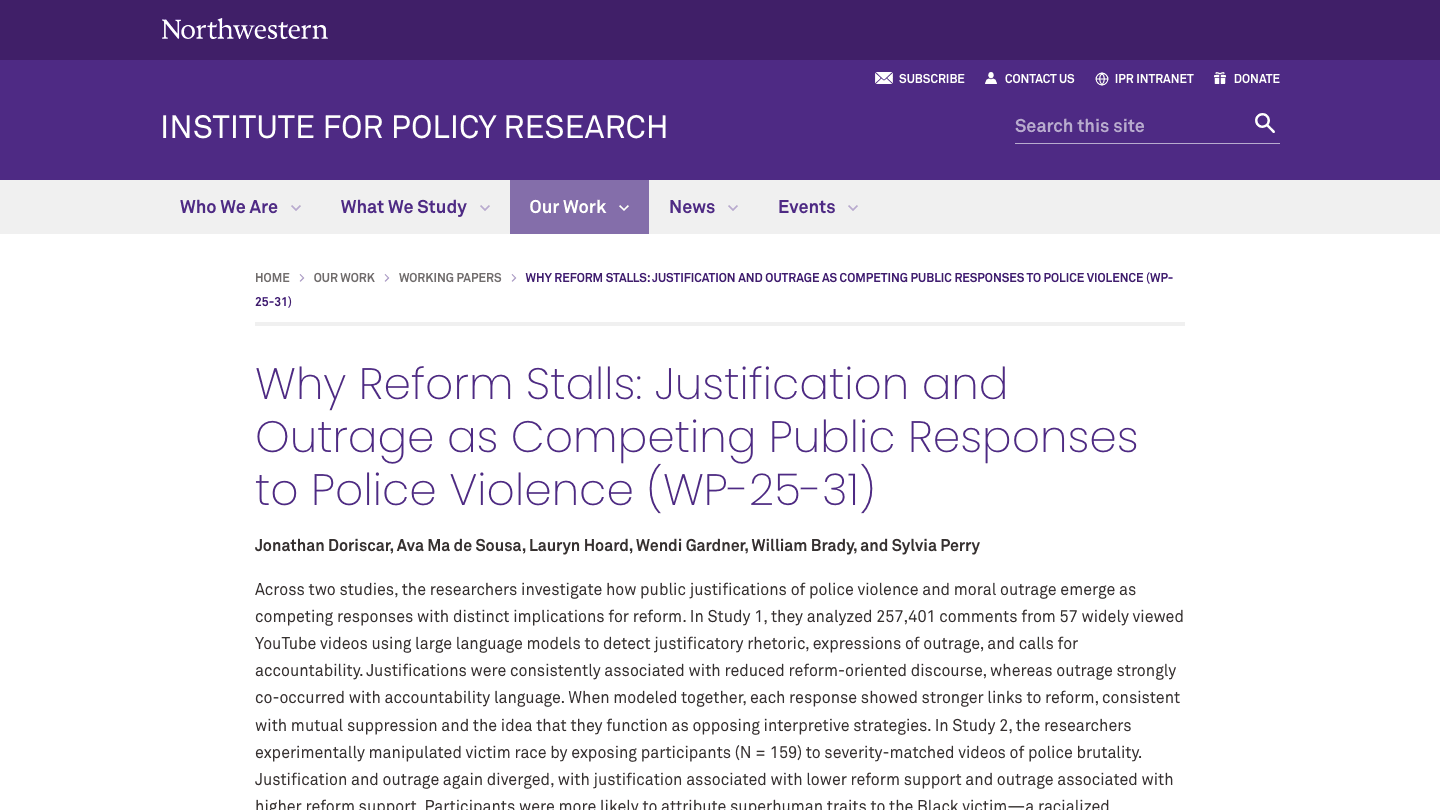
Why Reform Stalls: Justification and Outrage as Competing Public Responses to Police Violence
Northwestern IPR working paper WP-25-31.
The IPR page for a two-study working paper on justification, outrage, and reform discourse around police violence.
Open page

TGS Spotlight: Jonathan Doriscar
Northwestern's Graduate School spotlight page.
Northwestern Graduate School profile of my research, graduate training, and work in data science.
Open page
Publications.
From Data to Discovery: Unsupervised Machine Learning’s Role in Social Cognition
Social Cognition, 2025
Why Reform Stalls: Justification and Outrage as Competing Public Responses to Police Violence
Northwestern Institute for Policy Research Working Paper Series, WP-25-31, 2025
When the Specter of the Past Haunts Current Groups: Psychological Antecedents of Historical Blame
Journal of Personality and Social Psychology, 2024
Assessing How Energy Companies Negotiate with Landowners When Obtaining Land for Hydraulic Fracturing
Nature Energy, 2024
Funding and honors.
National Science Foundation Graduate Research Fellowship
Competitive graduate fellowship supporting my research training in cognitive science and computational methods.
Edward Bouchet Graduate Honor Society Scholar
Honor recognizing scholarly achievement and broader commitments in graduate education.
Contact
Get in touch.
Have a question or project in mind? I’d be glad to hear from you.